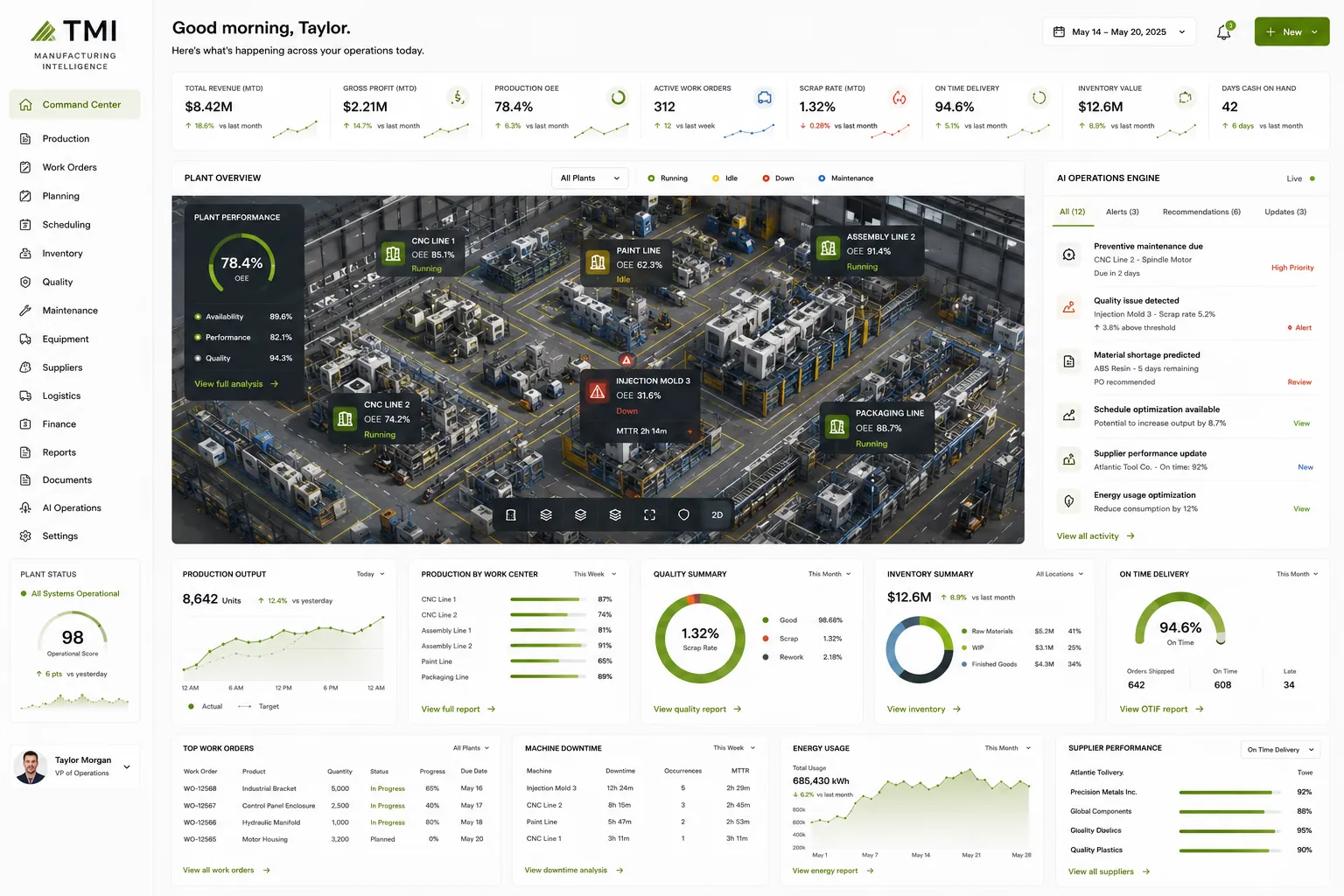
TMI builds the predictive infrastructure manufacturers need to stop reacting to equipment failures and start preventing them - predictive maintenance, anomaly detection, inventory automation, and shift reporting built to your production floor.
Start with The Audit - $997 →Custom infrastructure that connects equipment data, production monitoring, inventory, and compliance into one operating layer your team does not have to manage manually.
Monitors sensor data from your equipment - vibration, temperature, pressure, current draw - and detects failure signatures before breakdowns happen. The system learns each machine's baseline and generates alerts when readings start drifting toward failure, with a recommended service window that fits your production schedule.
Monitors production data streams in real time and flags deviations from expected ranges. Catches quality issues, equipment drift, and process variations before they compound into scrap runs or customer returns. The system learns normal operating patterns for your specific environment and alerts when something falls outside those bounds.
Tracks parts consumption against predictive maintenance schedules so critical components are on hand before they are needed. Reorder triggers are automatic. Vendor lead times are factored into stock levels. You stop discovering a machine needs a part that takes three weeks to arrive only after it breaks down.
Digitizes inspection checklists and routes quality data from the line into the reporting system automatically. Defect patterns are tracked across shifts, machines, and operators. When a quality issue starts trending, it surfaces in the dashboard before the batch hits shipping - not after a customer complaint.
Generates end-of-shift reports automatically by pulling production data, equipment status, quality flags, and open maintenance items into a structured briefing. Incoming supervisors get a complete picture without relying on verbal handoffs. Critical items escalate automatically. Information gaps between shifts stop costing you production time.
Tracks environmental reporting requirements, safety certifications, equipment inspection schedules, and regulatory filing deadlines in one dashboard. Audit-ready documentation is generated automatically. When an inspector asks for records, you pull the report in minutes instead of spending a week assembling spreadsheets from multiple systems.
| Capability | TMI | UpKeep | Samsara (Ops) | SAP PM |
|---|---|---|---|---|
| Predictive failure detection from sensor data | Machine-level models built to your equipment | Reactive work orders only | Fleet-focused, not production equipment | Available - requires major implementation |
| Production anomaly detection | Real-time monitoring against your baselines | Not available | Not available | Requires separate QM module |
| Automated shift handoff reporting | Auto-generated from live production data | Manual forms only | Not available | Not native - requires customization |
| Predictive parts inventory management | Reorder based on failure probability | Basic min/max stock levels | Not available | Available - complex to configure |
| Integration with existing SCADA/PLC | Built to your existing systems | Limited sensor integrations | IoT sensors - new hardware required | Native SAP integration only |
| Quality inspection workflow automation | Digital checklists - trend analysis built in | Not available | Not available | QM module - separate license |
| Implementation timeline | 8-12 weeks | 2-4 weeks | 4-8 weeks | 12-24+ months |
| Custom-built vs off-the-shelf | Built for your operation | Generic platform | Generic platform | Generic enterprise platform |
We map your equipment, identify your highest-cost downtime risks, review your current data infrastructure, and produce a specific build plan with ROI projections. You walk away with a clear picture of what gets built and what it returns before any significant investment is made. The $997 applies toward your project.
TMI builds predictive models against your actual equipment data, integrates with your existing SCADA and MES systems, and constructs the reporting and alert infrastructure. Four to seven weeks depending on integration complexity. Every system is built to your production environment - not configured from a generic template.
Systems go live. Your team gets trained on the controls and alert protocols. One to two weeks. The predictive models continue improving in accuracy over the first 60 to 90 days as they learn your equipment's specific patterns. You own the infrastructure without ongoing per-seat software fees.
Predictive maintenance consistently delivers the highest ROI in manufacturing. Catching a bearing failure before it happens costs a fraction of an unplanned shutdown - and most facilities experience multiple preventable breakdowns per year. At 8% of capacity lost to preventable downtime, recovering even half of that is significant. Anomaly detection on production data is the second highest return, catching quality deviations before they become scrap runs.
TMI builds models that monitor equipment sensor data - vibration, temperature, pressure, current draw - and establish baseline patterns for each machine. When readings start deviating from normal in ways that historically precede failures, the system generates a maintenance alert before the equipment goes down. The alert includes the specific machine, the anomaly pattern, and a recommended service window that fits your production schedule rather than forcing an emergency shutdown.
Anomaly detection monitors production data streams in real time and flags deviations from expected ranges. This catches quality issues, equipment drift, and process variations before they compound into scrapped runs or customer returns. The system learns normal operating patterns for your specific production environment and alerts when something falls outside those bounds - not just when something crosses a fixed threshold set during initial configuration.
Yes. TMI builds integration layers that connect to existing SCADA, PLC, and MES systems. We work with the data your equipment already generates rather than requiring hardware replacement. For older equipment without existing telemetry, TMI can specify sensor retrofits as part of the Audit and Build phase. The goal is to use what you have and add to it strategically, not to require a full infrastructure replacement.
Shift handoff automation generates end-of-shift reports automatically by pulling production data, equipment status, quality flags, and open maintenance items into a structured briefing. The incoming shift supervisor gets a complete picture of where the operation stands without relying on verbal handoffs or someone remembering to fill out a form at the end of a long shift. Critical items escalate automatically so they do not get buried in the notes.
Both. The systems are built to your production environment. Process manufacturers get continuous monitoring of flow rates, temperatures, and chemical parameters with deviation alerts. Discrete manufacturers get machine-level cycle time tracking, quality inspection workflows, and OEE reporting. The Audit phase determines which systems apply to your specific operation before anything is built.
Most manufacturers are fully operational in 8 to 12 weeks. The Audit takes two weeks to map your equipment, data sources, and operational gaps. Build runs four to seven weeks depending on integration complexity and the number of machines being monitored. Installation and team training takes one to two weeks. Predictive maintenance models improve in accuracy over the first 60 to 90 days as they learn your equipment's specific patterns.
Every engagement starts with The Audit at $997. The Audit maps your equipment, identifies your highest-cost downtime risks, and produces a specific build plan with ROI projections. Full project scope is determined after the Audit based on the number of machines, integration complexity, and systems prioritized. Most manufacturers recover the project cost from a single prevented unplanned downtime event.
UpKeep is a work order management system - it tracks what your team does after a problem is reported. TMI builds predictive systems that identify failures before they happen and connect maintenance, production, and inventory into a single operating layer. TMI is not software your team logs into to manage work. It is infrastructure that runs the operation and surfaces what needs attention before it becomes a crisis.
Yes. TMI builds multi-site architectures that give plant managers a view of their individual facility and give operations leadership a consolidated view across locations. Each plant gets its own monitoring configuration tuned to its specific equipment. Performance comparisons across plants are built into the reporting layer so you can identify which facility's practices produce the best results and replicate them elsewhere.
Two weeks. A complete map of your production operation, every downtime risk quantified, and a specific build plan. $997 - applies toward your project if you move forward.
Start with The Audit - $997 →