The Platform
Built for ag operations.
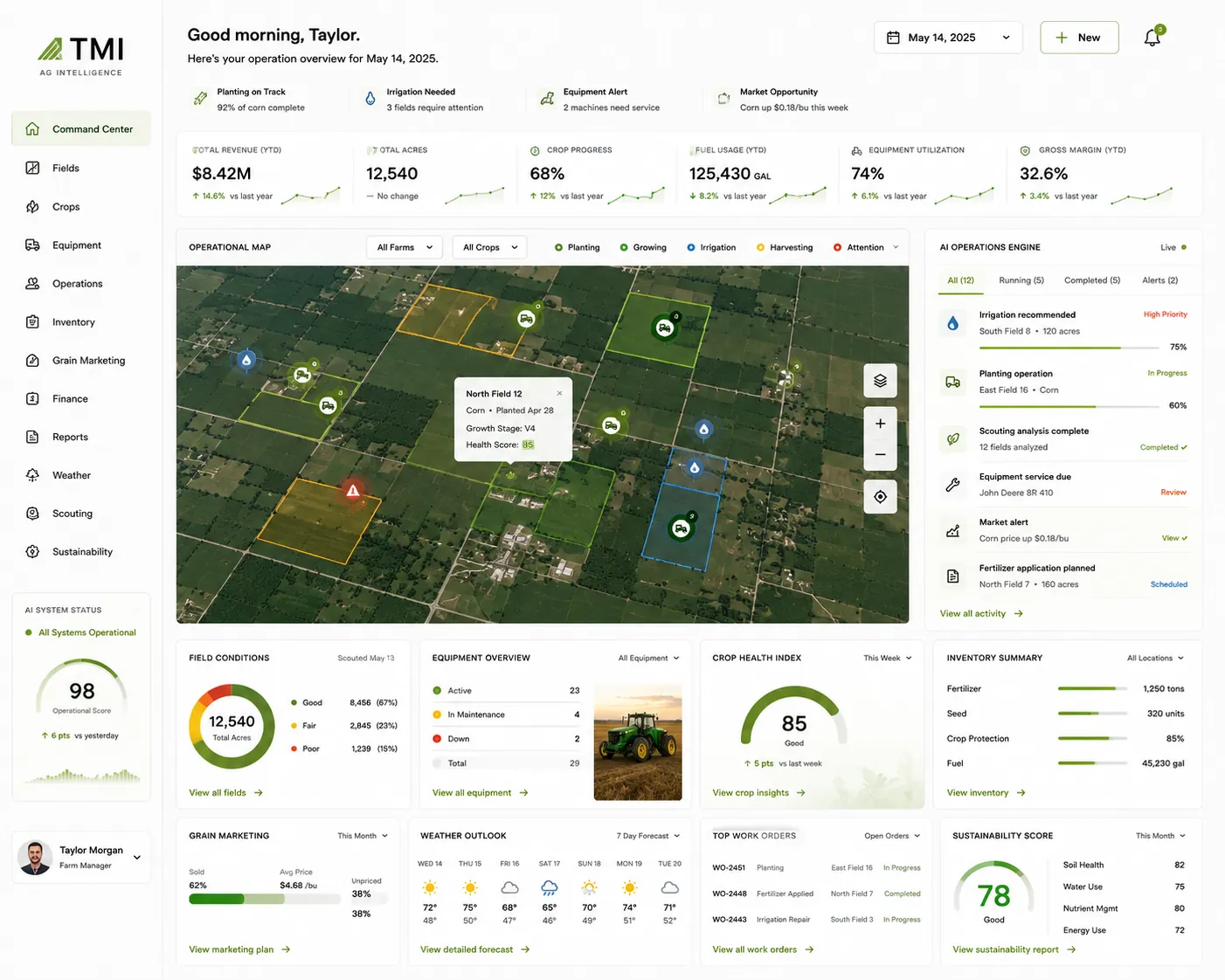
Full farm command center - field conditions, equipment status, crop health, and an AI operations engine running analysis across every acre.
Farm operations, food production, and agribusiness at scale. We build the systems that coordinate equipment, labor, and compliance across the seasons - so nothing falls through when the window is narrow.
Seasonal windows, dispersed equipment, labor complexity, and compliance requirements create pressure points that generic software was never designed to handle.
A combine that goes down during harvest isn't just a repair - it's potentially tens of thousands in missed yield. Without visibility into equipment health, failures surprise you at the worst time.
Managing crews across fields, shifts, certifications, and payroll during peak season is a scheduling and compliance challenge that spreadsheets and phone calls can't keep up with.
Food safety, environmental, and USDA requirements tracked manually - in email threads, binders, and disconnected apps - with real legal and financial exposure when something slips.
Real-time status tracking across tractors, combines, irrigation systems, and field equipment - with predictive maintenance alerts before failure windows open.
Crew scheduling, certification tracking, and shift coordination automated across planting, growing, and harvest cycles - with payroll data captured in the field.
Food safety, environmental, and regulatory documentation generated automatically - FSMA, GAP, EPA chemical records - so audits don't require a week of prep.
Yield data, cost-per-acre, input costs, and crop progress in one dashboard - accessible from the office or the cab. Real numbers while the season is still running.
Inputs, chemicals, seed, and parts tracked across locations - with reorder triggers, vendor coordination, and cost reconciliation handled automatically.
Field activity logs, spray records, yield reports, and incident documentation captured in the field and filed automatically - never manually re-entered.
Full farm command center - field conditions, equipment status, crop health, and an AI operations engine running analysis across every acre.
Every system designed around the operational reality of farming - where windows are short, margins are tight, and a missed day costs more than a year of software.
Not a software demo. Not a consultant deck. A real system installed and running in your operation.
30 minutes. We map your current operation, find where the gaps are costing you most, and tell you exactly what to build first.
We design and build every system around how your business actually runs. No templates. No generic software. Built for you.
We install, train your team, and hand over a system that runs without us in the room. Most operations are live in 6-8 weeks.
One call. We walk every process, bottleneck, and gap in your workflow. Nothing gets assumed. Nothing gets skipped.
Custom intelligent infrastructure built specifically for how you operate. Done for you. 14 days max. No templates. No generic software.
Your team gets trained. The system runs. We stay on for support. You never deal with a generic software vendor again.
Planting, spraying, irrigation, and harvest activities logged per field and per operator automatically. You know what happened and when.
Every piece of equipment gets a maintenance schedule tied to hours and seasonal use. Service appointments book automatically before breakdowns happen during peak season.
Seed, chemical, and fertilizer inventory tracked per operation. Usage logs tie inputs to specific fields. Waste and over-application become visible.
Seasonal crew schedules, task assignments, and completion tracking in one system. You know what got done and what is still outstanding.
Harvest data captured per field and per crop automatically. Yield reports compile without manual spreadsheet work.
Supplier contacts, open purchase orders, and delivery schedules tracked in one place. Input deliveries arrive when you need them.
We build a field activity logging system that captures every operation - spraying, planting, irrigation, harvest - tied to the specific field and date. You have a complete record without anyone manually entering data at the end of the day.
Yes. Every machine gets a maintenance schedule based on hours and seasonal use. Service alerts fire automatically before planned maintenance is due. You stop finding out a planter is down when planting starts.
Seed, chemical, and fertilizer inventory gets tracked as it moves. Usage ties back to specific fields. You know your cost per acre without building a spreadsheet manually.
Seasonal crew scheduling, task assignment, and daily completion tracking all live in the system. You know what got done in each field by end of day.
14 days from the discovery call to deployment.
Beyond the systems, TMI installs entire offices, staffed by digital workers that own a whole function end to end and run inside the same operating layer. Start with the one that fixes your most expensive problem.
Tell us about your operation. We'll build around your equipment, crews, and the seasons that define your year.
Every engagement starts with the Complete Audit. We map exactly how your business runs, then delete the software you don't use, connect what's left, and build the systems and AI that run it. You own what we build.
We audit your stack and cut the software nobody uses. Less to manage and smaller bills, from day one.
We wire what is left into one operational layer, so nothing lives in a silo and the whole operation is visible.
We build the systems and AI that run the work you used to run by hand. Deployed, your team trained, handed over.
One door in. Every engagement starts with the Complete Audit: a detailed map of your operation, your Intelligence Score, and the 30-day plan to fix it.
Book a call →Related Industries